





Managing projects in post-conflict and disaster zones APM
New APM report reveals how project managers can deliver in extreme environments.
Contents |
[edit] A Volatile, Uncertain, Complex and Ambiguous world
The war in Ukraine has highlighted an uncomfortable truth. Our world is becoming increasingly Volatile, Uncertain, Complex and Ambiguous (VUCA). Events that are described as ‘once in a lifetime’ or ‘once a generation’ are becoming regular occurrences. In the past three years alone, we have seen a global pandemic, an energy crisis, record-breaking temperatures and now an economic crisis. It’s rapidly becoming more important than ever that project and programme managers adopt an awareness of the skills needed to deliver projects in uncertain times.
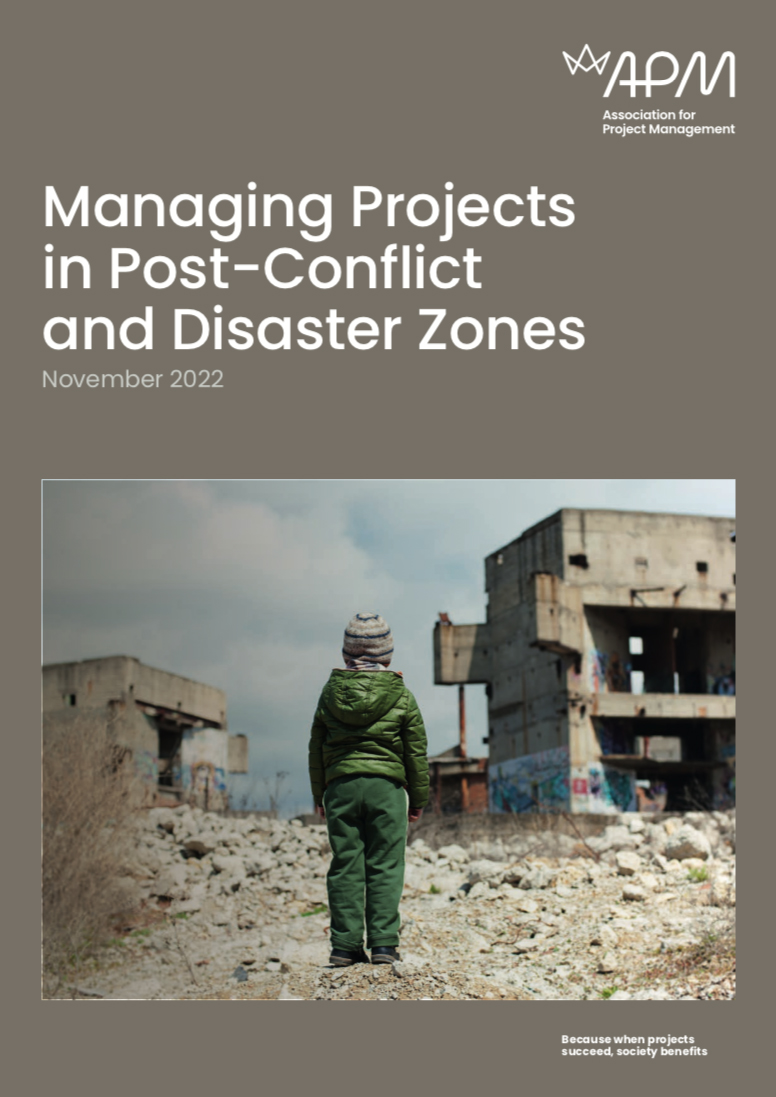
By drawing on the insights of those who have operated in some of the most challenging environments on the planet, Association for Project Management (APM) has published a new report, Managing Projects in Post-Conflict and Disaster Zones, which shares the key learnings from their experiences of delivering projects.
[edit] Recognising the specific skillset
Project management in extreme environments requires a specific skillset, but what does this look like? And what does it take to be effective in this arena? Managing Projects in Post-Conflict and Disaster Zones shares insights from professionals working in the military and humanitarian non-governmental organisations on bringing structure to chaotic situations through good project management.
While there is no doubt that good projects have always been adaptive and responsive, our changing and challenging world means this has become even more critical. This means many insights from the report can also be applied to ‘regular’ project management.
James Simons, APM’s Content Publishing Manager, said: “While the catalyst for this paper has been the war in Ukraine, the fact that we live in turbulent times means that project professionals must be adaptive and ready to pivot when called on to do so. Delivering projects in extreme circumstances is becoming increasingly commonplace, even in the UK. We therefore encourage all project professionals to take-away the learnings from this report; many of which can be applied to any type of project.”
[edit] Learnings from those who are used to dealing with extreme situations
[edit] When things get unclear, reaffirm your project’s purpose
The more uncertain the environment, the greater the focus should be on the overall impact rather than very specific results and outcomes.
Contributor, Lt Col Langley Sharp ran The Centre for Army Leadership and is author of Habit of Excellence: Why British Army Leadership Works. He explained: “You have to define the purpose of the mission and communicate it to everyone.
“If the purpose is clear, it galvanises everyone together… whenever things are seemingly so overwhelming, so complex, and so unachievable that fractures occur in your team, you must focus back on: what is your aim? What is the purpose of being here - the mission? That focus of mind allows you then to prioritise what work needs to be done and when it needs to be done.”
[edit] Use an agile approach if things are changing quickly
An agile approach is favoured for most emergency situations, especially in the initial response as it allows for any change as more information becomes available. The greater the element of emergency, then the argument grows for working in a more agile way.
It’s important to decide what the right method is for your project. For example, a sequential approach – with linear phases – may be appropriate for slow-burn development work in a relatively stable environment. But in emergency situations a more agile approach is required. Whatever the approach, the plan must be well communicated and understood.
Lt Col Langley Sharp strongly supports a flexible and adaptive approach to cope with today’s changing requirements, he commented: “With the complexity of the world today, linear plans are almost non-existent.”
[edit] Fully engage with stakeholders to support project success
Project managers must always engage with key stakeholders directly impacted by the project. This ensures everyone affected understands the goals and will be more likely to be on board.
Dan Connors, an ex-military intelligence officer who is Co-founder of Applied Influence Group, says that “influence mapping is a useful tool that can capture all the key stakeholders, their relationships, and what is driving them in terms of motivations. Nevertheless, the objective of stakeholder management is not just to understand what people want; it’s also to gain their trust and credibility so that you can achieve what you have set out as your objectives”.
[edit] Remember, all projects are delivered by people:
- All project managers should have compassion, whether it’s a humanitarian situation or a high-stress situation, leaders have a duty of care.
- It’s important to understand the individual strengths and vulnerabilities to maximise the ability of the team.
- Encouraging people to talk about issues and providing a safe space to decompress can be effective ways to support their well-being.
You can read the full report here.
This article appeared as "New APM report reveals how project managers can deliver in extreme environments" on the APM News and Blog site dated December 1, 2022.
--Association for Project Management
[edit] Related articles on Designing Buildings
- APM articles.
- After Mexico - earthquakes and resilient cities.
- Avoiding disaster in existing buildings and infrastructure.
- Climate change.
- Disaster.
- Earthquake Design Practice for Buildings.
- Earthquake resistant building materials.
- Earthquakes and the seismic strengthening of churches.
- Flood.
- Future proofing construction.
- Helping communities recover from disasters and protecting them before they occur.
- How to rebuild using the debris from disasters.
- Hurricane design considerations.
- Project manager.
- Managing and Responding to Disaster.
- Natural disaster.
- Research and development in disaster response.
- Sendai Framework for Disaster Risk Reduction.
- Summerland disaster.
- Ten years on – Lessons from the Flood on building resilience.
- Tropical cylcone.
- Tsunami.
Featured articles
Check out some of the best features and news from Designing Buildings as well as key stories from around the web.

Updated supplier guide can help electrical contractors engage with NHP.

CIAT confirm the winners of the 2026 architectural technology awards.

Government launches a one stop shop for flood preparedness.

Sir Edwin Lutyens: Britain's greatest architect? Book review.

CIOB publishes free template to help assess and manage risks.
ECA's reflections on Party Conference season

Burnham wants to be confident of winning before asking for a fresh mandate.
New Chief Construction and Scientific Adviser

Sergio Cavalaro, Professor of Infrastructure Systems at Loughborough University.
Building safety levy for England

CIAT publish estimator tool for members.

Water sector faces a growing crisis that could slow the delivery of vital infrastructure.
Undervaluing our industrial past

Heritage value changes as taste for building styles changes.
Changing expectations around competence and compliance

New information sheet from CIAT.
Grenfell investigation files passed to CPS

Angela Rayner apologises on behalf of the British state.